How to Fix Database Race Conditions
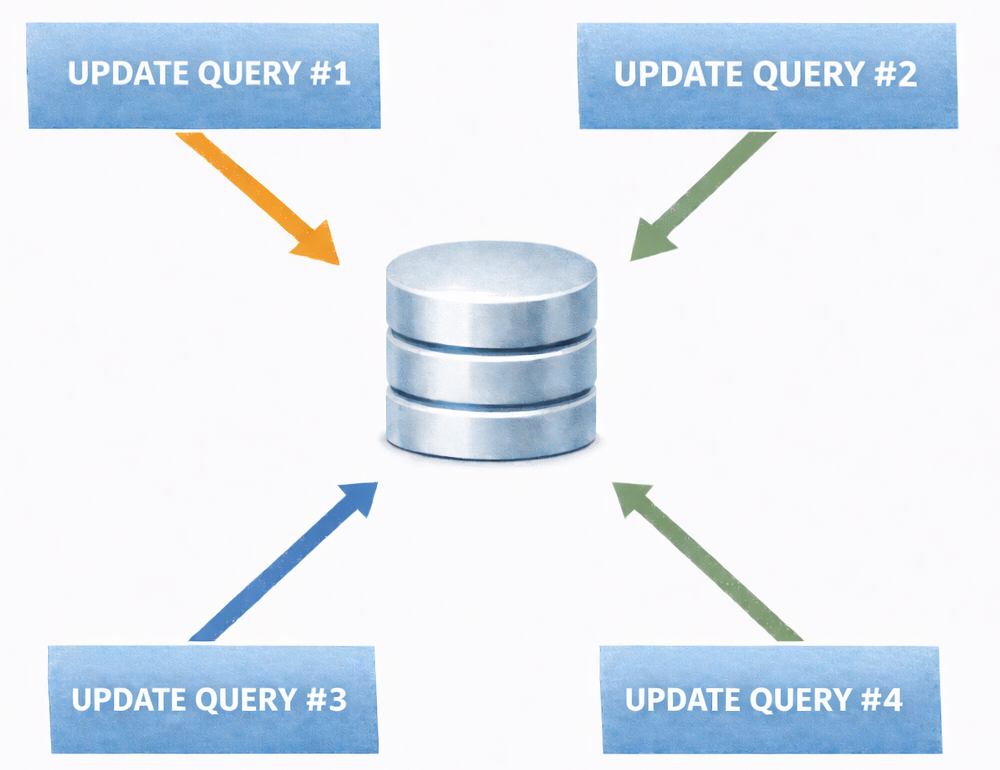
Race conditions aren't unique to any database system; they affect relational databases such as PostgreSQL, MySQL, SQL Server, and Oracle alike. Solving them requires a mix of transactional controls, locking strategies, and careful query design. In this article, we'll explore race conditions in depth, provide real-world examples, and detail proven solutions across popular databases. By the end, you'll have the tools to safeguard your data against these concurrency pitfalls.
Understanding Race Conditions
At their core, race conditions stem from the non-atomic nature of operations in concurrent environments. Databases handle multiple connections, and without proper synchronization, operations like “check-then-act” can fail. For instance, consider a banking app where two transactions withdraw from the same account:
Transaction A reads the balance as $100.
Transaction B also reads $100.
Transaction A deducts $50, writing back $50.
Transaction B deducts $60, writing back $40—overdrawing the account.
This “lost update” is a classic race condition. Other types include “dirty reads” (reading uncommitted data), “non-repeatable reads” (inconsistent reads within a transaction), and “phantom reads” (new rows appearing mid-transaction).
These issues are exacerbated in distributed systems or microservices, where latency adds unpredictability. ANSI SQL defines isolation levels—Read Uncommitted, Read Committed, Repeatable Read, and Serializable—to mitigate them, but higher isolation comes at a performance cost due to increased locking.
Common Scenarios and Examples
Race conditions often appear in scenarios involving shared resources:
Inventory Management: An e-commerce site checks stock (e.g., 5 items left), then decrements. If two users check simultaneously, both might proceed, selling 6 items.
Counter Increments: Social media likes or view counts. Without protection, increments can be lost.
Unique Constraints: Inserting records with unique IDs generated on-the-fly, leading to duplicates.
In code, this might look like (pseudocode):
SELECT balance FROM accounts WHERE id = 1; -- Application logic: if balance > amount, then UPDATE accounts SET balance = balance - amount WHERE id = 1;If interleaved, updates collide.
Solutions to Race Conditions
Addressing race conditions involves balancing consistency, availability, and performance. Here are key strategies:
1. Use Transactions and Isolation Levels
Wrap operations in transactions to ensure atomicity. Set appropriate isolation levels:
Read Committed (default in many DBs): Prevents dirty reads but allows non-repeatable reads.
Repeatable Read: Ensures consistent reads but may allow phantoms.
Serializable: Highest isolation, treating transactions as sequential, but prone to deadlocks.
BEGIN TRANSACTION ISOLATION LEVEL SERIALIZABLE; -- Your queries COMMIT;Higher levels use more locks, so use judiciously.
2. Pessimistic Locking
This approach locks resources upfront, preventing concurrent access. Use SELECT ... FOR UPDATE to lock rows during reads.
Example in an inventory check:
BEGIN; SELECT quantity FROM products WHERE id = 1 FOR UPDATE; -- If quantity > 0, then UPDATE products SET quantity = quantity - 1 WHERE id = 1; COMMIT;If another transaction tries the same, it waits or times out.
Pros: Strong consistency. Cons: Reduced concurrency, potential deadlocks.
3. Optimistic Concurrency Control
Assume conflicts are rare and check for changes at commit time. Use version columns (e.g., timestamp or integer) to detect modifications.
Add a version column to tables. When updating:
SELECT id, data, version FROM table WHERE id = 1; -- Application modifies data, then UPDATE table SET data = new_data, version = version + 1 WHERE id = 1 AND version = old_version;If rows affected = 0, a conflict occurred—retry.
Pros: Better for read-heavy workloads. Cons: Requires retry logic, can lead to “thundering herd” in high contention.
4. Other Techniques
Atomic Operations: Use database-built-ins like UPDATE ... RETURNING or stored procedures for single-statement atomicity.
Queueing Systems: Offload contentious operations to message queues (e.g., RabbitMQ) for serialized processing.
Distributed Locks: In clustered setups, use tools like Redis for external locking.
Constraints and Indexes: Enforce uniqueness at the DB level to prevent invalid states.
Database-Specific Implementations
Databases offer tailored features for handling race conditions.
PostgreSQL
PostgreSQL excels in concurrency with Multiversion Concurrency Control (MVCC). It defaults to Read Committed but supports all isolation levels.
For locking: SELECT ... FOR UPDATE NOWAIT skips if locked, avoiding waits.
Advisory locks provide application-level synchronization:
SELECT pg_advisory_lock(123); -- Lock key 123 -- Critical section SELECT pg_advisory_unlock(123);Row-level locking is granular, minimizing contention. For sequences or counters, use SERIAL types or nextval() safely.
In high-load scenarios, PostgreSQL’s REPEATABLE READ prevents most anomalies, but monitor for serialization failures.
MySQL (InnoDB)
MySQL’s InnoDB engine uses row-level locking and MVCC. Default isolation is Repeatable Read, which uses gap locks to prevent phantoms.
Pessimistic locking:
SELECT * FROM table WHERE id = 1 FOR UPDATE;For optimistic control, use version columns with dynamic row formats.
MySQL also supports user-defined locks:
SELECT GET_LOCK('my_lock', 10); -- Timeout 10s -- Critical section SELECT RELEASE_LOCK('my_lock');Be cautious with auto-increment columns in replicated setups, as they can cause races—use UUIDs instead.
InnoDB’s undo logs help rollback, but tune innodb_lock_wait_timeout for production.
Other Databases
SQL Server: Uses optimistic isolation via row versioning (SNAPSHOT). Locking hints like WITH (UPDLOCK) are common.
SELECT * FROM table WITH (UPDLOCK, READPAST);Oracle: Relies on MVCC and undo segments. SELECT ... FOR UPDATE SKIP LOCKED ignores locked rows. Use DBMS_LOCK for custom locks.
MongoDB (NoSQL): Handles concurrency via optimistic updates with $inc operators or transactions in version 4.0+. Use findAndModify for atomic find-update.
Monitor with tools like pg_stat_activity or PERFORMANCE_SCHEMA to detect deadlocks.
Best Practices
Test Under Load: Use tools like JMeter to simulate concurrency.
Minimize Transaction Scope: Keep transactions short to reduce lock times.
Handle Errors: Implement retries with exponential backoff.
Choose Right Strategy: Pessimistic for high contention, optimistic for low.
Audit and Log: Track anomalies with triggers or extended events.
Scale Horizontally: Shard data to reduce per-instance contention.
Avoid over-reliance on application-level checks; push logic to the database for atomicity.
Conclusion
Race conditions can turn robust systems fragile, but with transactions, locking, and concurrency controls, they’re manageable. PostgreSQL’s MVCC shines for complex queries, while MySQL’s InnoDB offers solid defaults. Tailor solutions to your workload—whether banking transactions demand serializable isolation or a blog’s like counter needs simple atomic updates.
Implementing these techniques ensures data consistency without sacrificing performance. As databases evolve, core principles remain: anticipate conflicts, lock wisely, and verify atomically. By mastering these, you’ll build scalable, reliable applications that stand the test of concurrency.