Google launches Genie 4 for interactive world simulation
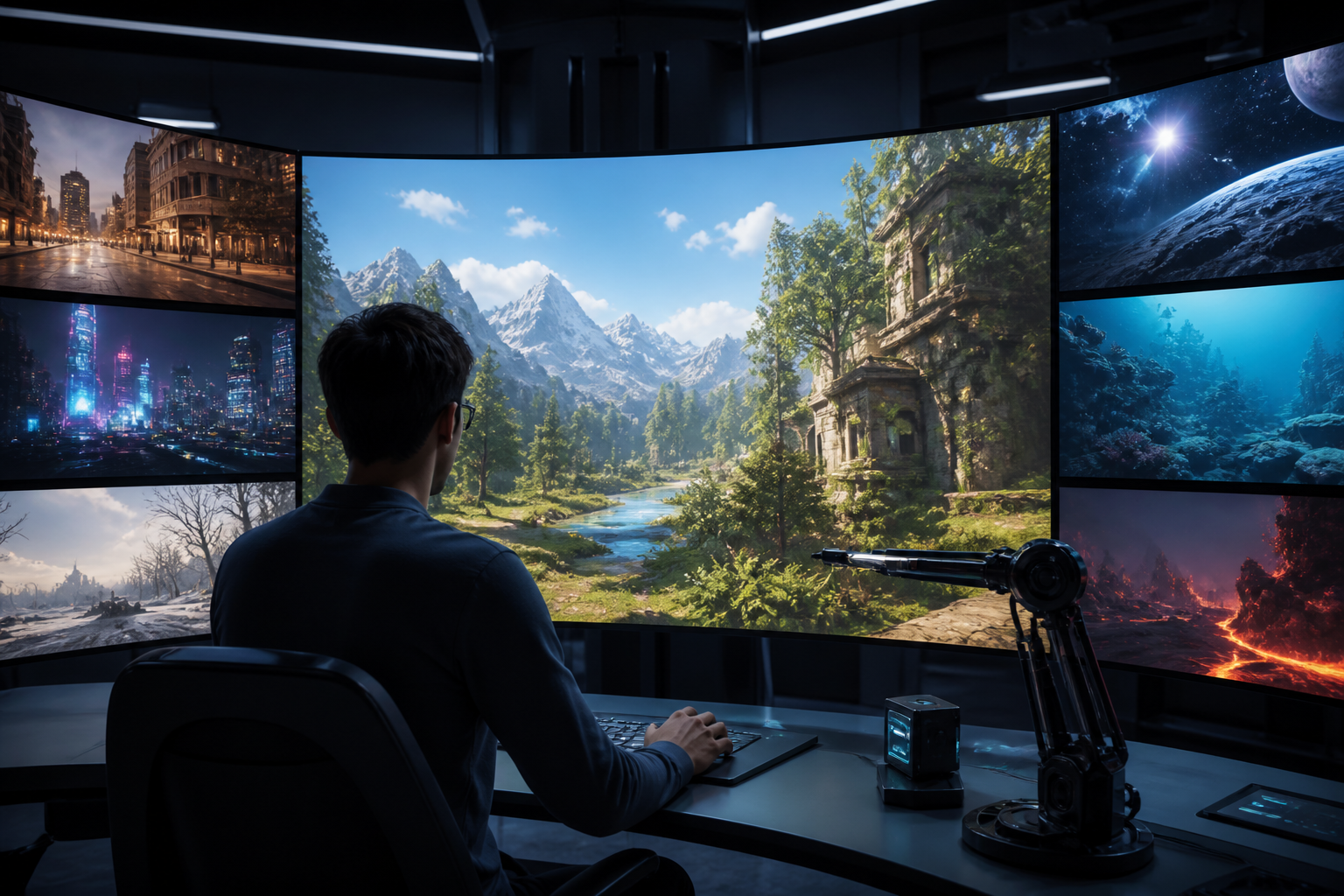
Google released Genie 4 this week as its most advanced world model to date. The system generates interactive environments that respond in real time to user inputs while producing consistent visuals, synchronized audio, spoken dialogue, and physical changes such as weather shifts or object interactions. Demonstrations shared internally and on public channels showed users directing characters through city streets, altering building layouts mid-scene, and triggering conversations that adapt to new contexts without breaking continuity.
Core Capabilities Demonstrated
Unlike earlier versions that focused on short video clips or static scene generation, Genie 4 maintains temporal coherence across extended sessions. Users steer the simulation through keyboard, mouse, or natural language commands, and the model updates lighting, soundscapes, and NPC behaviors accordingly. One widely circulated clip featured a user directing a robot arm inside a factory floor; when the operator requested a change in conveyor speed, both the visual motion and the corresponding mechanical audio adjusted instantly.
Engineers at Google DeepMind emphasized that Genie 4 was trained on a mixture of video, audio, and action data collected from simulated and real-world sources. The architecture combines a latent dynamics model with multimodal generation heads, allowing separate control over visual rendering, audio synthesis, and dialogue generation while keeping them aligned through a shared world state representation. This separation enables developers to swap in different visual styles or voice models without retraining the underlying physics and logic layers.
Why the Demos Went Viral
Short clips posted on developer forums and social platforms spread rapidly because they showcased immediate interactivity rather than pre-rendered sequences. Viewers could see the model handle unexpected inputs, such as sudden object collisions or improvised dialogue requests, without visible artifacts or loss of consistency. The combination of real-time audio generation with visual updates set Genie 4 apart from prior image-to-video systems that lacked sound or required offline processing.
Within hours of the announcement, independent researchers began testing the public preview endpoints. Early experiments included constructing simple game prototypes where players navigate procedurally generated dungeons while the model generates ambient sound and enemy chatter on demand. These experiments highlighted how the model could reduce the asset creation burden for small teams working on interactive experiences.
Background and Technical Evolution
Genie 4 builds directly on the lineage of earlier Google world models. The original Genie focused on learning action-conditioned video prediction from unlabeled internet videos. Subsequent iterations added higher resolution output and basic audio tracks. Version 4 introduces a unified latent space that encodes both visual and auditory information alongside explicit action tokens, allowing the model to simulate longer horizons with fewer drift errors.
Key architectural changes include a hierarchical planner that operates at multiple timescales: a fast reactive layer handles immediate physics responses while a slower planning layer maintains narrative or task-level coherence. This design helps prevent the model from forgetting distant context when users issue rapid successive commands.
Industry Reactions and Debate
Robotics researchers noted that Genie 4 could serve as a high-fidelity simulator for training manipulation policies before transferring them to physical hardware. Several labs reported plans to fine-tune their existing reinforcement learning agents inside the new model to test zero-shot transfer on tasks such as drawer opening or block stacking. Gaming studios expressed interest in using the system for rapid prototyping of level layouts and dynamic NPC interactions, though they cautioned that production pipelines would still require human oversight for narrative consistency and performance optimization.
AGI researchers framed the release as incremental progress toward systems that can maintain rich internal models of the world. Some argued that the ability to generate consistent multi-modal responses from high-level instructions represents a meaningful step beyond narrow perception models. Others pointed out that Genie 4 still relies on large-scale supervised data and lacks explicit mechanisms for long-term planning or causal reasoning that many consider essential for AGI.
Practical Considerations for Developers
Access to Genie 4 is currently available through a controlled API that returns synchronized video and audio streams along with state metadata. Developers can send action vectors or natural language instructions and receive updated frames at interactive frame rates on high-bandwidth connections. Rate limits and compute costs remain significant factors for extended sessions, prompting some teams to explore hybrid setups that cache static background elements while querying the model only for dynamic foreground changes.
Security and safety teams highlighted the need for guardrails around generated dialogue to prevent the model from producing harmful or misleading speech. Google stated that content filters trained on curated datasets are active by default, with options for enterprise users to add custom policies.
Looking Ahead
Future updates are expected to expand the range of supported physics interactions and add support for multi-agent scenarios where several independent users influence the same environment. Researchers are also investigating methods to distill Genie 4 into smaller, faster variants suitable for edge deployment in robotics hardware. While the current release demonstrates impressive coherence, sustained progress will depend on continued improvements in training efficiency and evaluation benchmarks that measure long-horizon consistency rather than single-frame quality.
The broader conversation this week centers on how world models like Genie 4 might reshape workflows across creative and engineering disciplines. Teams that previously spent weeks building custom simulators now have access to a general-purpose starting point that can be steered through language or direct control. Whether this accelerates discovery in robotics or simply lowers barriers for game prototyping will become clearer as more groups publish results from extended use. For now, the release has supplied a concrete artifact that both enthusiasts and skeptics can examine and debate directly.