Meta Connect put AI glasses and Muse center stage
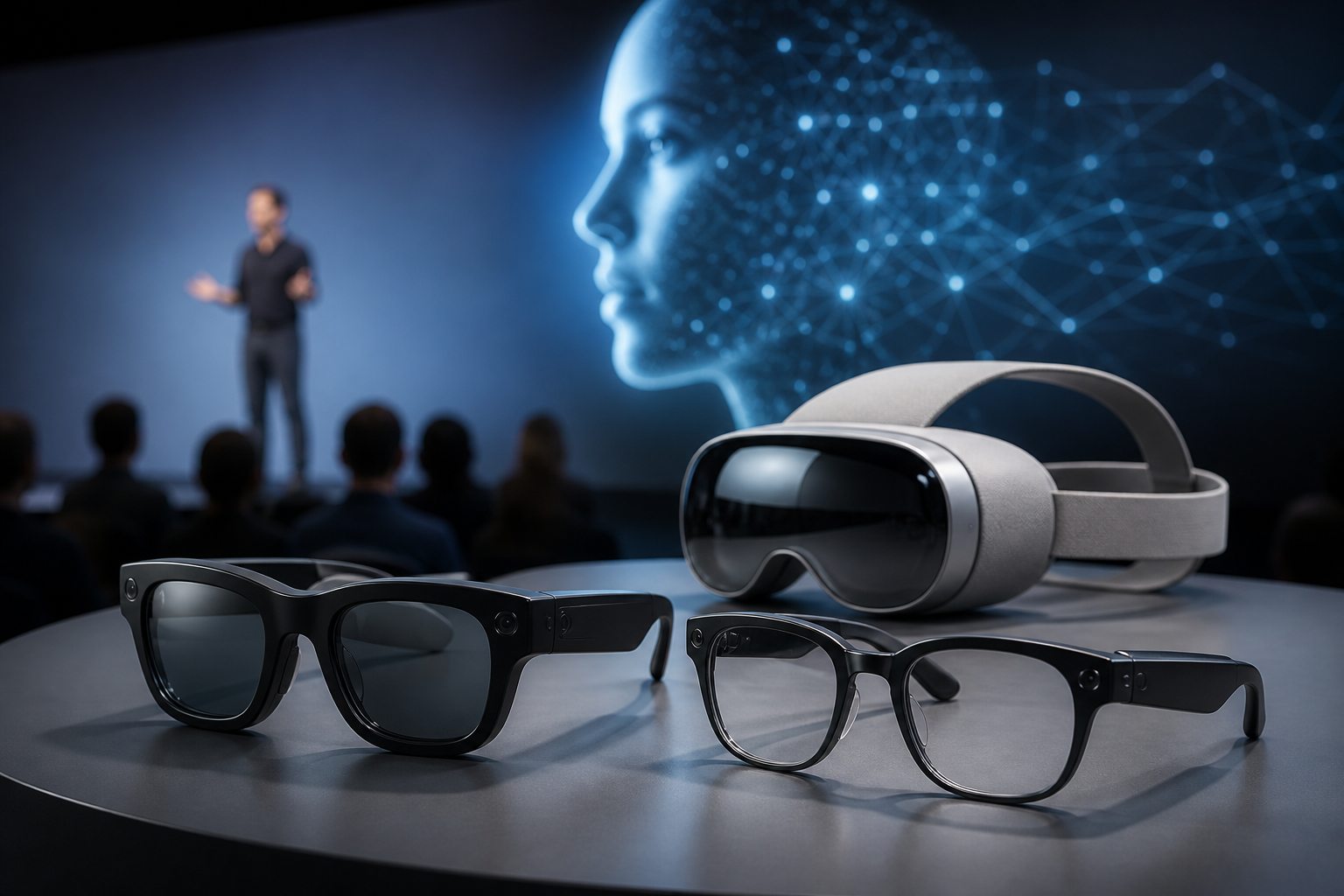
Meta used its Connect event on September 23 to roll out several hardware updates built around AI. The most visible were the Ray-Ban Meta Gen 3 smart glasses and a new camera-free Ray-Ban Meta Audio model. The company also showed lighter VR prototypes and expanded the role of its Muse personal agent across these devices. The moves are part of a larger bet that wearable form factors will become the default way people interact with AI models in daily life.
Hardware details released on stage
The Ray-Ban Meta Gen 3 glasses add improved cameras, longer battery life, and faster on-device processing for AI tasks. Engineers at the event demonstrated real-time captioning and object recognition running directly on the frames without sending every frame to the cloud. A new camera-free version removes the imaging hardware entirely and focuses on audio playback and voice interaction, targeting users who want the form factor without visual capture capabilities.
Lightweight VR glasses were shown as a prototype aimed at longer wear sessions. These units reduce weight compared with current Quest headsets and include new sensors for eye tracking and facial expression capture. The devices are positioned as a bridge between full virtual reality and lighter augmented overlays that could eventually run on the same AI stack as the Ray-Ban line.
Muse integration across devices
Muse, Meta’s personal agent, received the largest software update of the day. It now maintains context across glasses, phones, and VR sessions. Users can start a conversation on the Ray-Ban frames, continue it inside a VR workspace, and have the agent surface relevant notes without manual prompting. The agent also gained new tool-calling abilities that let it interact with third-party services such as calendar and email providers.
Developers received updated APIs that expose Muse capabilities through the same interface used for the glasses. Early partners can register custom skills that run both on-device and in the cloud, with the system choosing the execution location based on latency and privacy settings. This unified approach is intended to reduce the need for separate apps for each wearable.
Why the announcements drew attention
Meta is attempting to move AI out of the phone and into always-available wearables. The strategy assumes that users will accept cameras and microphones on their faces if the value of instant assistance outweighs privacy concerns. The camera-free Audio model serves as an explicit concession to those concerns while still capturing the audio-interaction market.
Competitors have released similar products, yet Meta’s scale in distribution through the Ray-Ban partnership gives it an immediate retail channel. The company also controls the underlying model training data from its social platforms, which it can use to fine-tune Muse for personal memory and social context. This combination of hardware reach and data advantage is what analysts see as Meta’s primary edge.
Reactions from developers and users
Software engineers at the event noted that the new APIs reduce the amount of custom code needed to support multiple form factors. One attendee described the unified Muse interface as “closer to writing a single web app than maintaining separate mobile and headset codebases.” Privacy researchers raised questions about data retention policies for the always-listening audio models, though Meta stated that users can delete recordings at any time through account settings.
Early user feedback on social channels focused on battery life and comfort. The Gen 3 frames are reported to last roughly six hours with heavy AI use, an improvement over the prior generation but still short of a full workday for some professionals. The lighter VR prototypes received praise for reduced front-heavy weight, though field-of-view numbers were not disclosed during the keynote.
Implications for software teams
Teams building AI features now have a clearer path to deploy across glasses and VR without separate code paths. The emphasis on on-device inference means engineers must optimize models for limited RAM and thermal envelopes. Meta released benchmark numbers showing that certain vision tasks run at 15 frames per second on the Gen 3 hardware, providing a concrete target for third-party developers.
The decision to offer a camera-free SKU also creates a product segmentation question. Companies planning enterprise deployments must decide whether to standardize on the full-featured glasses or the audio-only variant based on data-handling policies. This choice will likely influence how internal tools are designed over the next year.
Next steps Meta signaled
Meta plans broader availability of the Gen 3 glasses before the end of the year and said the lightweight VR units will reach select developers in early testing programs. Muse updates are already rolling out to existing Ray-Ban Meta owners through an over-the-air release. The company did not announce pricing for the new models during the event, leaving that detail for later retail listings.
Overall, the September 23 announcements reinforce Meta’s view that the next interface layer after smartphones will sit on users’ faces. The combination of familiar Ray-Ban styling, optional camera hardware, and a persistent personal agent gives the company a concrete product line to test that hypothesis at scale.