Tech giants sign voluntary White House AI accord
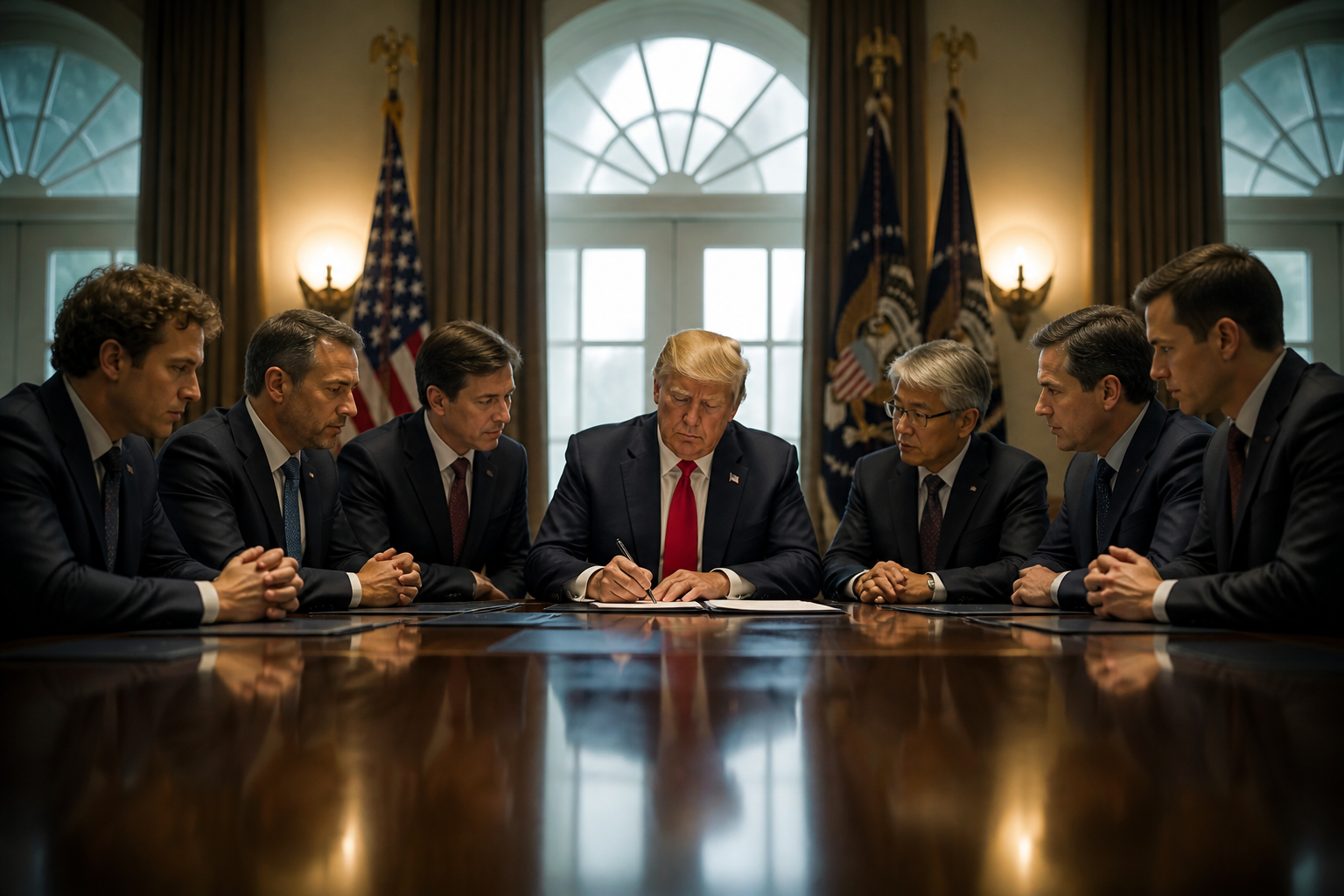
On Tuesday, September 29, representatives from Google, Meta, OpenAI, Anthropic, Nvidia, and xAI met with President Trump to sign a voluntary AI accord. The document calls for each company to conduct internal safety reviews of their frontier models and to submit to external evaluations by independent parties. Because the accord carries no legal penalties for noncompliance, the event immediately triggered debate about whether companies developing the most powerful AI systems can be trusted to oversee their own work.
Details of the Accord
The text of the agreement asks signatories to document risk assessments before releasing new models and to share high-level findings with a yet-to-be-named external panel. No specific benchmarks or red-team protocols are mandated, leaving each firm free to define its own testing scope. The White House described the step as a first move toward coordinated oversight while preserving the speed of American AI development.
Why the Story Dominated Headlines
Frontier AI systems now demonstrate capabilities in code generation, scientific reasoning, and multi-step planning that were considered experimental only two years ago. As these capabilities approach thresholds discussed in safety literature, lawmakers and researchers have pressed for clearer accountability structures. The voluntary nature of the September 29 accord placed the question of credible self-policing squarely in public view, prompting engineers, investors, and policy staff to weigh the practical limits of internal review processes.
Companies at the Table and Their Current Positions
Google operates Gemini models and maintains an internal responsible-innovation team that already runs adversarial testing. Meta continues to release large language models under open weights, a strategy that complicates external review because weights can circulate beyond company control. OpenAI and Anthropic have both published safety frameworks in the past year that include staged deployment gates. Nvidia supplies the dominant training hardware and therefore sits at the center of any discussion about compute-based safety thresholds. xAI, the newest entrant, has focused on rapid iteration with its Grok series and has not previously committed to third-party audits.
Background on AI Safety Practices
Internal safety reviews typically combine automated benchmarks, human red-teaming, and scaling-law analysis to estimate dangerous capabilities before release. External reviews add independent researchers who receive model access under nondisclosure agreements and attempt to surface failure modes the developer may have missed. Both approaches rely on the assumption that dangerous behaviors can be detected in controlled settings, an assumption still under active study in the research community.
Reactions from the Technical Community
Many machine-learning engineers welcomed any formal commitment to documentation, noting that ad-hoc testing has often been deprioritized under product deadlines. Others pointed out that without standardized evaluation suites or public release of review summaries, the accord risks becoming a public-relations exercise rather than an engineering discipline. Discussions on internal forums centered on whether existing infrastructure for model evaluation can scale to the volume of checkpoints now produced during training runs.
Engineering Implications
Teams responsible for model training will likely need to allocate additional compute cycles for safety experiments and to maintain audit logs that external reviewers can inspect. Logging infrastructure must capture not only final model weights but also intermediate activations and fine-tuning datasets. Organizations that already operate continuous-integration pipelines for model evaluation may find it straightforward to extend those pipelines; teams without such tooling face a larger lift to meet even voluntary standards.
Next Steps and Open Questions
The accord leaves several operational details unresolved, including the composition of the external review panel and the frequency of required reports. Companies must now decide whether to publish redacted versions of their internal findings or to keep them confidential. Observers expect follow-on guidance from the White House within the next quarter that could clarify reporting formats and possible incentives for participation. Until those details emerge, engineering organizations are treating the September 29 agreement as a signal to strengthen their existing evaluation practices rather than a finished regulatory framework.